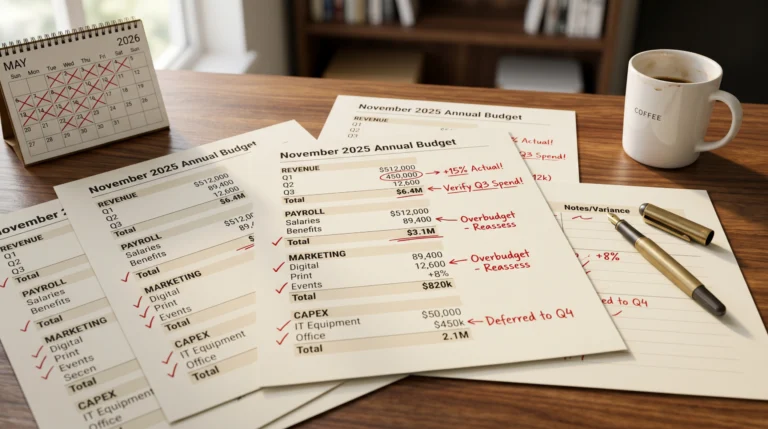


There's a number every small business owner checks all the time. Not margins, not the rolling forecast, not their cash conversion cycle. It's their bank balance. That's the first thing they check each morning, the number behind every hiring decision, every distribution.
It feels like the truest fact in the business. It's also one of the least useful.
Your bank balance is an ephemeral thing, a single frozen moment in a continuous flow of money. It doesn't show the $47,000 in receivables quietly aging, the payroll due in eleven days, or September's estimated tax payment. It doesn't show whether growing revenue is turning into profit or being absorbed by costs you haven't mapped. Most costly of all, it doesn't show what your next big decision will actually cost, in cash, in taxes, in opportunity, before you make it.
All your bank balance gives you is a number. It doesn't, it can't, tell you where your business is going.
Most owners experience an uncomfortable moment at midyear. The impact of the new hire you made in February finally shows up. The delayed pricing decision has had a quarter to validate itself or become a known mistake. Then the quarterly tax payment lands, and feels like an ambush, because it's disconnected from any deliberate decision.
That ambush feeling is the clearest signal a business is managing from its bank balance instead of real financial visibility.
All your bank balance gives you is a number. It doesn't, it can't, tell you where your business is going.
Fixing the misdiagnosis
When cash feels tight despite growing revenues, owners reach for the usual fixes: push harder on sales, cut costs reactively, hire or fire on instinct. None of these are wrong, necessarily, but none address the root cause: the business has outgrown its financial infrastructure. It has more complexity than visibility. That's not a cash problem. It's a visibility problem, and visibility problems have a specific solution.
Forward-looking financial leadership is that solution. A Fractional CFO doesn't interpret your bank balance, they build a system that makes it beside the point, because decisions get made earlier, with better information.
In practice, the Q3 hire is evaluated against a twelve-month rolling forecast, payroll tax included. The Q4 capital expenditure is weighed by after-tax cost and depreciation timing, not optimism and available credit. September's tax payment arrives as confirmation that the forecast held, not a surprise. And owner compensation is structured deliberately around projected profitability and entity form, rather than whatever feels affordable in the moment.
That's what real visibility produces: not just better numbers, but better decisions, made earlier, with the tax implications already understood.
July is the natural moment to ask: is your business running on visibility, or on hope? If cash flow feels perpetually uncertain and tax bills keep arriving as surprises, that's not a verdict on you as a leader. It's a structural gap, and structural gaps have structural solutions.
We've spent forty years between us turning struggling operations around — finding revenue the books were hiding and putting cash flow on a discipline our clients can sustain. We bring that operating discipline to every owner we serve.
The shift from managing by bank balance to leading with real financial visibility starts with one conversation. Schedule a discovery call to explore what Fractional CFO leadership could mean for your second half.