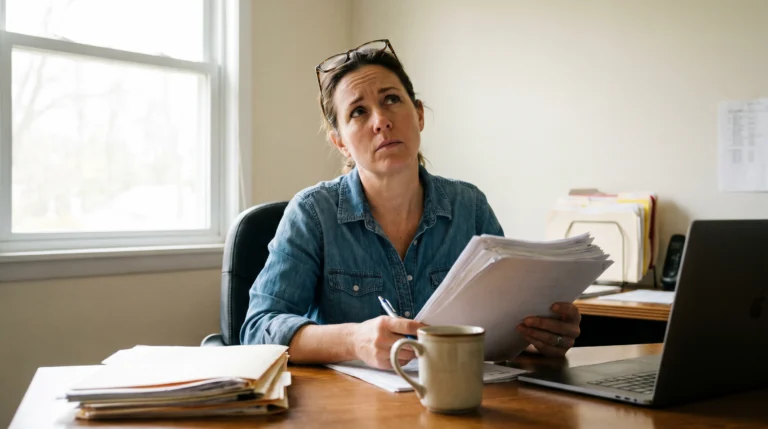


It's a familiar story across millions of business owners. An email from your CPA came in overnight with your return attached. You open the PDF, scroll to the last page, and there it is: federal balance due, $187,000. You read it twice. You scroll back up looking for the line item that explains it. You pull last year's return for comparison. Revenue was up, but not by that much. You don't understand where the number came from.
Your CPA didn't miss anything, and the return is correct. The problem is that it's seven months late. The issue isn't the number, it's that you're seeing it for the first time in April. Most businesses don't get into trouble because they owe tax. They get into trouble because they don't know what's coming.
You don't have a tax problem. You have a cash flow problem, because you have a planning-cadence problem.
By the time your return shows up in March or April, almost every lever that could have changed your tax bill has already expired. The deductions you didn't take. The capex you didn't invest in. The estimated payment you didn't rebalance. None of it was wrong, and none of it was missed by your CPA. It just happened on a calendar used by governments, and not by you.
The calendar your tax bill actually runs on
Almost every lever that affects your federal tax bill closes by December 31. Equipment purchases, employee retirement contributions, owner compensation adjustments, receivables timing if the business is on cash basis. By February, when your CPA starts compiling the return, the year is locked. They're calculating, not deciding. The calculations are right. The decisions just happened, or didn't happen, months earlier.
What's missing isn't tax expertise. It's tax expertise running on the right calendar. Someone holding a rolling projection of where the return is heading, looking at it in August while there's still time to move pieces. The CPA can't do this in February. The math is over by then.
What a mid-August projection would have shown you
Say you run a $4M professional services firm. Q2 was strong, with a new enterprise retainer pushing revenue up 28%. By mid-August, six months of actuals are in the books. You run a projection against the year as it's tracking. There's a surprise.
Federal exposure comes back at $490K. Last year you paid $310K. You're looking at a $180K swing eight months before the return is due. Unlike next February, there's something you can do about it.
Four moves go on the calendar. The $140K equipment refresh planned for Q1 gets pulled into Q4 and placed in service before year-end. Your SEP-IRA contribution gets sized properly and funded on time. The September estimated payment is adjusted to hit safe harbor. A $45K invoice is pushed into January so the revenue is realized next year.
The combined effect: the $180K swing comes down to roughly $95K. That's not the real value. The real difference is this: April no longer feels like a surprise. You knew the number in August, you made decisions in September, and when the return showed up it confirmed what you already expected.
That's the shift. It's not whether you owe tax. It's when you find out.
You don't have a tax problem. You have a cash flow problem, because you have a planning-cadence problem.
Your CPA isn't doing this. Your bookkeeper isn't either.
Most business owners operate on a backward-looking reporting calendar. The bookkeeper records what already happened, and the CPA files a historical return. Both are doing their jobs. Neither is responsible for showing you what's coming while you still have options.
This is the difference between filing taxes and managing them. Between looking back and planning forward. A CPA reports the outcome. A CFO helps shape it. They manage with a rolling projection refreshed every quarter, on the calendar your tax bill actually runs on. They take mid-year readings on where things are heading, and they surface the decisions that need to be made while the calendar is still open. That's when the outcome is still flexible.
We've spent forty years between us turning struggling operations around — finding revenue the books were hiding and putting cash flow on a discipline our clients can sustain. We bring that operating discipline to every owner we serve.
This is where a Fractional CFO earns the fee, and provides a positive and meaningful ROI in the process. If your last April brought a number you didn't see coming, and you'd rather know in August than discover in March, Schedule a discovery call and we'll walk through what a mid-year projection would show for your business this year.