

Most business owners think they understand their numbers. If revenue is growing year over year, the pipeline looks full, and the team is busy, the business must be healthy. Right?
Not necessarily. Growth has a way of hiding problems until it exposes them.
We've put together a test for business owners, focused on some of the biggest headline numbers they watch and worry about. We hope you find it provocative and useful.
Revenue versus cash flow
Here's the first question: if revenue doubled tomorrow, would your cash position improve?
For many businesses, the answer is no, because growth consumes cash before it produces it. More customers mean higher delivery costs, more hiring, more working capital, more time between invoicing and payment. The faster the business grows, the faster it burns cash.
This is why so many growing companies feel paradoxically constrained. They are successful and short on cash.
It's not a revenue problem. It's a visibility problem. Cash flow pressure is one of the most common triggers for bringing in CFO-level leadership. Most small business failures are tied to cash flow issues, and companies that introduce Fractional CFOs frequently see measurable improvements in cash burn, profitability, and decision-making within the first year.
Rear-view mirror or crystal ball
Second question: are you directing the future or recording what already happened? This is a hard one. Most business owners actually live in the present, letting their bookkeeper and accountant count the beans while they themselves are too busy to plan or implement forward-looking solutions.
Most financial systems are backward-looking. They tell you where you've been, or at best, where you are now. The follow-up question: do you have a single forward-looking financial system? Not a budget, but a system that manages change?
Scale readiness is the one business dynamic that separates good businesses from growing businesses, and scaling requires something different: a forward-looking model. It requires predictive budgeting.
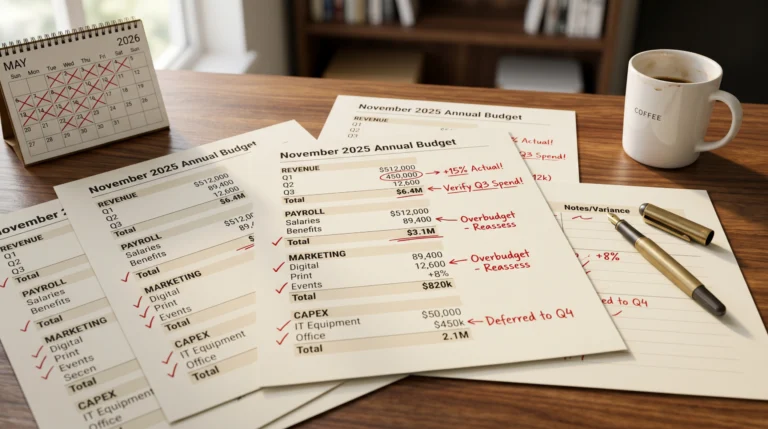
Predictive budgeting isn't about being right. It's about being early. It starts with a simple shift: instead of asking "what happened?" it asks "what is about to happen, and when?"
At its core, predictive budgeting is a rolling, forward-looking model built on three moving parts. Revenue timing, not just how much you sell, but when cash actually arrives. Cost structure, fixed versus variable, and how expenses scale with growth. Working capital dynamics, receivables, payables, and the lag between effort and cash.
When those three are connected, something important happens. You stop being surprised. You can see the cash gap forming before it hits. You can model the impact of a delayed client payment, a new hire, or a change in pricing, before making the decision.
Predictive budgeting isn't about being right. It's about being early.
In practice, this often looks like a rolling 12-month forecast that updates monthly. Actuals replace assumptions, and the future gets re-cut based on what just happened. Within a few cycles, most of the model is no longer "budget." It's reality, extended forward.
This is where financial leadership changes the game. Once you can see forward, you can choose. Slow hiring. Accelerate growth. Adjust pricing. Preserve cash. Without that visibility, every decision feels reactive. With it, the business starts to feel controlled.
Unit economics
Final question: does every new customer make you money? Not in theory, and not in your salesperson's incentive plan, but fully loaded in reality.
Here's what CFOs know: growth without unit economics is acceleration without direction. That's sometimes called flying blind.
Many businesses underestimate their true customer acquisition cost. Others overestimate lifetime value. The result is growth that looks impressive but erodes profitability. A CFO brings clarity here. They connect revenue to cost, acquisition to margin, and growth to sustainability. Often a hard head is more useful than a soft touch.
That hard-headed approach to customer acquisition pays off. According to Worldmetrics, Fractional CFOs increase client revenue by an average of 22% within 12 months, and 68% of clients see a reduction in cash burn rate within 6 months. Higher revenue combined with lower cash burn is sometimes called scalability, and it's the goal of many business owners.
This hasn't really been a finance test. It's a decision-making test. Do you have the visibility to understand what's actually happening in your business, or are you relying on lagging indicators and intuition?
Where the Fractional CFO fits in
Most owners don't need more effort. They need better information, delivered earlier. This is where a Fractional CFO earns the keep. Not as another bookkeeper or accountant, but as the architect of how a business scales. They reduce cash burn, align growth with economics, and replace hindsight with foresight.
The return shows up quickly. Industry data shows that many businesses see ROI within months, not years, through improved cash flow, cost structure optimization, and better growth decisions.
We've spent forty years between us turning struggling operations around — finding revenue the books were hiding and putting cash flow on a discipline our clients can sustain. We bring that operating discipline to every owner we serve.
Most businesses don't fail the financial literacy test because they lack intelligence or experience. They fail it because they lack visibility. Until that changes, growth will continue to feel harder than it should. If you'd like to talk about gaining greater visibility into your business, Schedule a discovery call.